Terraced Houses in South Wales

I’m currently sitting here in my office at 9pm, not having had dinner yet, writing my master’s dissertation about the plight of people who, like us, live in a stone-built terraced house in South Wales who don’t know where to find the right information about the care and maintenance of their house.

While listed, historic, heritage and conservation assets have apparently endless access to appropriate information, where do we get ours?  The answer is simple, it’s the very same information.  Penetrate through all the jargon and phrases about ‘non-designated heritage assets’ and ‘conservation of historic buildings’ and you will discover that the advice is there already.

Historic Environment Scotland (HES) and through their training centre in Stirling, the Engine Shed, have produced Technical Advice Notes (TANs) that are freely available and relevant to anyone whether you live in a castle, an 1890 pennant stone terrace in Eatontown or a 1910 brick terrace in Uplands.  The information is the same and remains relevant as long as your property is solid-walled.

The problems found in South Wales, which has a high percentage of concrete ground floors and cement mortar pointing, is the level of poor advice being provided so, if you search for Historic Environment Scotland (I know,the  but CADW website is rubbish) or www.thengineshed.scot, then you will get access to enough information to allow you to at least challenge your contractor about what they should be doing to your terraced house.  Sadly, some of the most appropriate work is still considered specialist as there is a process to go through when, for example, preparing stonework for repointing, caring for it during the curing process (you can’t just walk away) and finishing it off, which all needs understanding and time.

Unfortunately time is money so the most appropriate work can be more expensive depending on what it is but it is necessary and will solve issues such as dampness which plagues terraced houses throughout South Wales.  I try to do my bit to educate and provide great information on my website but I am a lone building suveyors voice amongst lots of contractors who think they know better.  They may in some cases but I know old buildings!

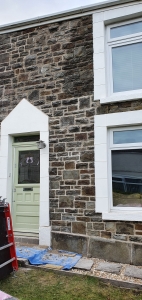
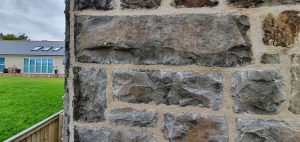
The photographs are mine.  1820 terrace, previously made damp by cement mortar, now dry thanks to lime mortar and Covid-19 which allowed me some time to do it.

A recent (and typical) enquiry about a damp wall

A recent phonecall recieved went along the lines of:

Caller: “I want to get a damp wall injected before it gets rendered”

Me: “Why do you want it injected?”

Caller: “The wall is damp, the damp proof course has broken down”

Me: “Damp proof courses don’t break down”

Caller: “But my wall is damp, I’m getting the render done anyway”

Me: “You need to identify where the water is coming in before you spend money rendering as the render will ensure the wall stays damp”

Caller: “The render needs fixed”

Me: “You need to find out what is causing the dampness before spending any money on it as it may remain wet.  There are numerous reasons for a damp wall from high ground levels, blocked ventilation, blocked or damaged drainage, poor detailing around windows, poor detailing at roof level, water ingress around chimneys, historic water ingress trapped by previous damp proofing etc.”

Caller: “It has been injected before, how long does it last?”

Me: “It doesn’t work.  There will be several problems causing the dampness that need to be remedied”

Caller: “I’ll get the render done and see how it goes”

Me: “!”

I did refer the caller to freely available documents on traditional building maintenence but I have little hope.  We are happy to provide free advice but you are clearly under no obligation to accept it.  🙂

Cavity Wall Insulation

There was an interesting article on Jeremy Vine’s show on BBC2 radio today (22nd July) about cavity wall insulation (CWI) and just how poor the contractors who installed it actually are.  The general synopsis is that it has mostly been mis-sold as there is nowhere in Wales or the west of Scotland it should have been installed.  This is due to the exposure (wind and rainfall combination) as it will make the insulation wet and act the opposite way to an insulation by drawing heat out instead of keeping it in.

This may have been news to some people but we have surveyed dozens of houses with wet CWI with clients successfully having it removed after applying to CIGA (Cavity Insulation Guarantee Agency).  CIGA, however, are headed by the industry bosses of the companies who installed the stuff in the first place.

The concern is, with the new proposals to boost the economy with another ill-thought-out round of insulation grants, we will face the same problem, house holders suffering issues with dampness.

The best way to keep heat in is to ensure your building is dry and it is maintained correctly and appropriately using the correct materials.  We can certainly help you with that so give us a call on 07944 611844 or email john@durieheritage.co.uk or alison@durieheritage.co.uk and we can discuss what we can do to help.