
Breathable floors
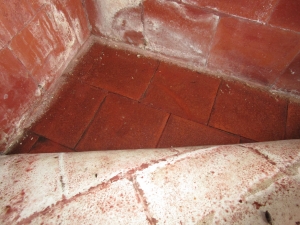
- How do you know when a floor is breathable?
- What can and can’t you do with a breathable floor?
- What happens when I cover a breathable floor?
- Why is my floor breathable?
All good questions, thanks for asking them…
Q. How do you know when a floor is breathable?
A. If you have a solid floor (not timber) in an old house and you know it hasn’t been altered before, it is likely to be breathable. Breathable means that it allow water vapour to travel through from the sub-base and evaporate through the floor covering – usually clay quarry tiles. The act of allowing evaporation prevents saturation of moisture on the surrounding walls.
Q. What can and can’t you do with a breathable floor?
A. What you can’t do (or shouldn’t do depending on the prevailing site conditions) is to cover a breathable floor. If you do, you risk ‘creating’ dampness as is shown in the photograph. This is a vinyl floor covering over quarry tiles. The floor is wet, not just damp, and the wall tiles show salt staining where groundwater has saturated in an attempt to evaporate and, where it has managed to, has left salt deposits behind. It is the surface area of the breathable floors that allows evaporation and prevents dampness. Clean the tiles and use a surface treatment that doesn’t seal them.
Q. What happens when a breathable floor is covered?
A. When a breathable floor is covered, the moisture can no longer evaporate through it, but it has to go somewhere, so it migrates through the attached structure (internal and external walls) trying constantly to evaporate or find an equilibrium. If it doesn’t, it causes it to become saturated and present as dampness.
Q. Why is my floor breathable?
A. The floor is breathable because the materials used to build the property – lime-based mortars and plasters, rely on the movement of water vapour to prevent dampness. Where these surfaces are sealed, by re-plastering using gypsum or re-pointing using cement, the conditions change and defects occur. Some clay tiled floors are laid over a layer of bitumen tar. Over time this becomes brittle and can fail where the subfloor material compacts so causing the bitumen to break. In a damo site, ground water may then seep through to make the area slightly damp. The surrounding conditions which are causing the floor to be damp must be dealt with. This can include altering ground levels, repairing below ground drainage, improving ventilation, maintaining the external fabric, etc. All of these defects can be identified following a survey from us.


