Covid-19 Update 2

Now that our beaches and parks are full with the early summer sunshine, it seems that the risk of infection by Covid-19 has gone.  I don’t believe it has and the recent packed venues will likely cause sharp a spike in infections and resultant deaths.  It is not just ther attendees who place themselves at risk, it is the many and multiple layers of people that they will eventually come into contact with that will be at risk too.  Shop-keepers, delivery drivers, NHS workers, office workers, factory workers, all of whom are required to come into contact with numerous surfaces and materials in their work.

It beggars belief that so many people could be so short-sighted.

We remain safe, have been shielding, and we wear masks when inspecting properties which can be very uncomfortable but, we feel, necessary for our own and our client’s health, and frequently use hand sanitiser throughout the day.

That way, we are as sure as we can be that we will limit our exposure to and risk of infection but while still providing excellent and timeous service to our clients whether you are looking for a building survey, timber and damp survey or your old, damp house or you are looking for peace of mind that a pre-purchase condition survey will provide.

Stay safe and continue to be responsible.

Covid-19 update

Staff News 2

University of bath logo

John has begun a Masters dergee at the University of Bath to study the Conservation of Historic Buildings.  This is to cement (or should it be lime) his knowledge of historic and traditional buildings, design, structural matters and their failures.

A knock-on effect of this course is a reduction of availability for survey work however all enquiries will be answered quickly, as normal, and accomodation made where possible.

Staff News

Chimney maintenance

Breathable floors

  • How do you know when a floor is breathable?
  • What can and can’t you do with a breathable floor?
  • What happens when I cover a breathable floor?
  • Why is my floor breathable?

All good questions, thanks for asking them…

Q.    How do you know when a floor is breathable?

A.    If you have a solid floor (not timber) in an old house and you know it hasn’t been altered before, it is likely to be breathable.  Breathable means that it allow water vapour to travel through from the sub-base and evaporate through the floor covering – usually clay quarry tiles.  The act of allowing evaporation prevents saturation of moisture on the surrounding walls.

Q.    What can and can’t you do with a breathable floor?

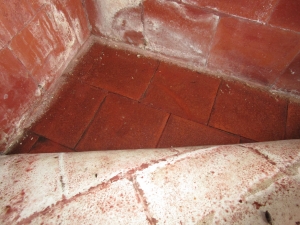
A.    What you can’t do (or shouldn’t do depending on the prevailing site conditions) is to cover a breathable floor.  If you do, you risk ‘creating’ dampness as is shown in the photograph.  This is a vinyl floor covering over quarry tiles.  The floor is wet, not just damp, and the wall tiles show salt staining where groundwater has saturated in an attempt to evaporate and, where it has managed to, has left salt deposits behind.  It is the surface area of the breathable floors that allows evaporation and prevents dampness.  Clean the tiles and use a surface treatment that doesn’t seal them.

Q.    What happens when a breathable floor is covered?

A.    When a breathable floor is covered, the moisture can no longer evaporate through it, but it has to go somewhere, so it migrates through the attached structure (internal and external walls) trying constantly to evaporate or find an equilibrium.  If it doesn’t, it causes it to become saturated and present as dampness.

Q.    Why is my floor breathable?

A.    The floor is breathable because the materials used to build the property – lime-based mortars and plasters, rely on the movement of water vapour to prevent dampness.  Where these surfaces are sealed, by re-plastering using gypsum or re-pointing using cement, the conditions change and defects occur.  Some clay tiled floors are laid over a layer of bitumen tar.  Over time this becomes brittle and can fail where the subfloor material compacts so causing the bitumen to break.  In a damo site, ground water may then seep through to make the area slightly damp.  The surrounding conditions which are causing the floor to be damp must be dealt with.  This can include altering ground levels, repairing below ground drainage, improving ventilation, maintaining the external fabric, etc.  All of these defects can be identified following a survey from us.

Regional Property Surveyors for Scotland and Wales

Do Scotland and Wales simply face worst weather conditions?

Property Care Association and the truth about CSRT

When do you know if you really are getting the best advice?

The Dangers of Asbestos in Older Buildings

Asbestos is a known carcinogenic mineral that was used extensively in a number of industries in the UK for decades.

New stained glass for Pendower Hall

Heritage & Design Ltd has been asked to design new stained glass panels for the main staircase at the historic Pendower Hall in Newcastle.